
Glagolitic Script – Senj Printing Press


Senj is known, among other things, as a Glagolitic city. The Senj Tablet, found on the staircase of Nehaj Fortress during restoration work, shows that Glagolitic script was already as widespread in the 11th century as it was on the nearby island of Krk. It is one of the oldest Croatian Glagolitic monuments, created almost simultaneously with the Baška Tablet. The tablet has not been preserved in its entirety; only fragments with carved floral ornaments and Glagolitic letters were found. These preserved fragments are now kept in the Senj City Museum.
After the Senj Tablet, there are no written records of Glagolitic usage for a long time, until a letter from Pope Innocent IV in 1248 to the Senj bishop Filip, granting him permission to conduct church services in the Old Church Slavonic language using the Glagolitic script.
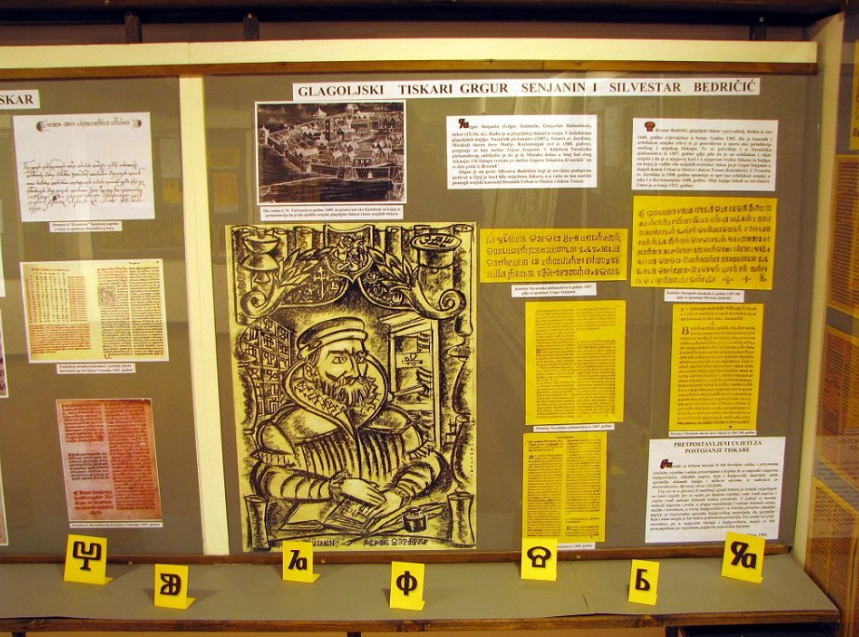
Only about fifty years after the invention of the printing press, a group of people appeared in Senj who recognized the importance of this invention. One of them was Blaž Baromić, one of the most important figures in Croatian cultural history. In 1493, he printed a breviary in Venice that bears his name. Five copies of his breviary have been preserved: two in the National and University Library in Zagreb, and one copy each in the State Library in Munich, the Parma Library in Schwarzau (Austria), and in Sibiu (Romania).
After printing the breviary, Baromić returned to Senj and the following year acquired all the necessary equipment to establish a printing press. On August 7, 1494, the first and most valuable work of the Senj printing press was printed — the Missal. The Missal is a book containing all the texts used at Mass throughout the liturgical year. The language of the Missal is Croatian Church Slavonic.